Modern backend systems need to be fast, scalable, and efficient. Users expect applications to respond instantly, but as applications grow, performance often becomes a challenge.
In a typical web application, when a user requests data, the server queries a database like PostgreSQL or MongoDB. This works well initially, but imagine an API receiving thousands of requests every second. If every request hits the database, complex queries and disk access can quickly slow things down.
Over time, the database becomes a performance bottleneck, increasing response times and degrading user experience.
This is where Redis comes in.
Redis is an in-memory data store that allows applications to retrieve data extremely fast by storing frequently accessed data in memory. Because of this, it has become one of the most widely used technologies in modern backend systems. Companies like Twitter, GitHub, Pinterest, and StackOverflow use Redis to improve performance and handle large-scale traffic.
What is Redis?
Redis stands for Remote Dictionary Server.
It is an in-memory key–value data store used as a database, cache, and message broker.
Unlike traditional databases that store data on disk, Redis stores data in memory (RAM). Because of this, Redis can perform operations extremely fast often in microseconds.
At its core, Redis works like a dictionary:
key → value
Example:
user:1 → "john"
product:12 → "Laptop"
session:abc123 → user data
Why is Redis So Fast?
The main reason Redis is fast is because it stores data in RAM instead of disk.
Traditional databases need to:
- read from disk
- parse queries
- access storage layers
Redis skips most of this, making the workflow much simpler:
Application → Redis (RAM) → Response
Instead of milliseconds, Redis responses often take microseconds.
This makes Redis ideal for situations where speed is critical.
Redis Data Structures
Redis supports multiple powerful data structures.
1. Strings
The simplest and most common data type.
Example:
SET name "Saurabh"
GET name
2. Lists
Lists store ordered collections of elements, similar to an array.
Example:
LPUSH tasks "task1"
LPUSH tasks "task2"
3. Sets
Sets store unique values.
Example:
SADD users "user1"
SADD users "user2"
4. Hashes
Hashes store objects with fields and values.
Example:
HSET user:1 name "Saurabh"
HSET user:1 age 18
5. Sorted Sets
Sorted sets store values with a score, allowing ordered data.
Example:
ZADD leaderboard 100 "player1"
ZADD leaderboard 200 "player2"
Real World Use Cases of Redis
Redis is rarely used as a primary database. Instead, it is commonly used as a performance layer.
Here are some real-world use cases.
1. Caching
Caching is the most common Redis use case.
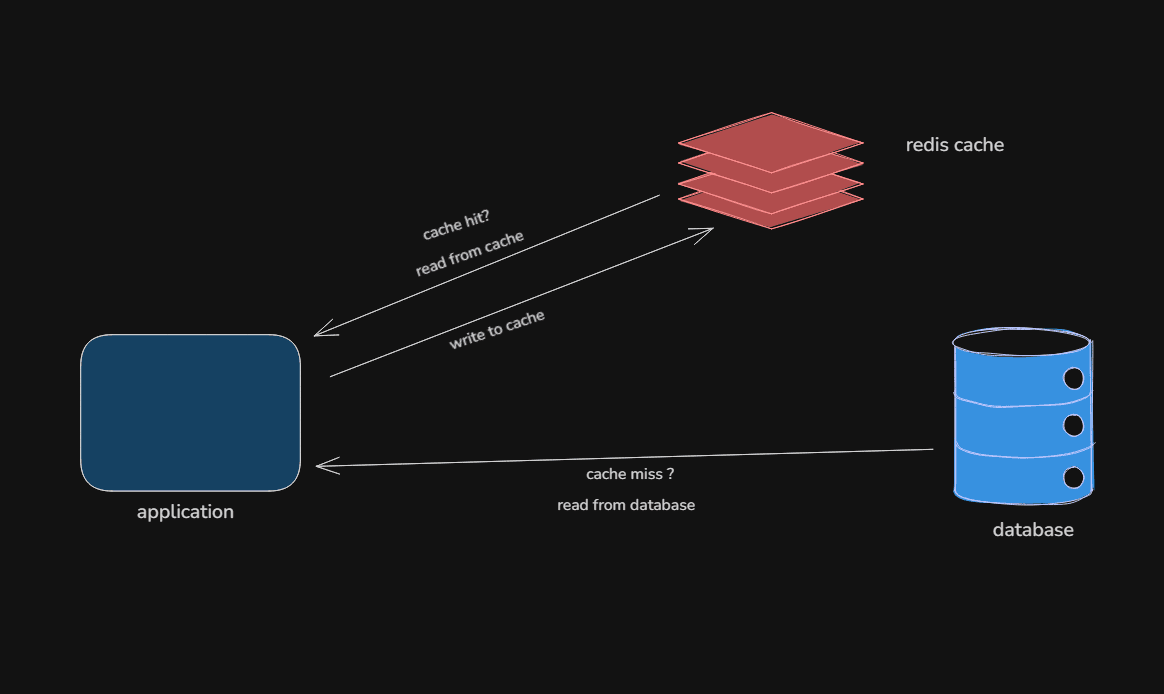
Example workflow:
Client → API → Redis → DatabaseProcess:
- API checks Redis first
- If data exists → return instantly
- If not → fetch from database
- Store result in Redis
2. Rate Limiting
APIs often limit how many requests a user can make.
Example:
User can only make 100 requests per minuteRedis can track request counts efficiently using commands like:
INCR
EXPIRE
This is commonly used in public APIs.
3. Job Queues
Redis lists can be used to create task queues.
Example tasks:
- sending emails
- processing images
- background notifications
Workers pull tasks from Redis and process them.
4. Leaderboards
Gaming platforms often use Redis sorted sets.
Example:
player → scoreRedis can instantly return:
- top players
- rankings
- score updates
A Simple Way to Think About Redis
You can think of Redis as a super-fast layer that sits between your application and the database.
Instead of asking the database for the same data again and again, the application can quickly fetch it from Redis, reducing load on the database and improving response times.
Resources
- Redis Docs → https://redis.io/docs/
- Redis Tutorial → https://youtu.be/Vx2zPMPvmug?si=CzWcGH6atpiHU439